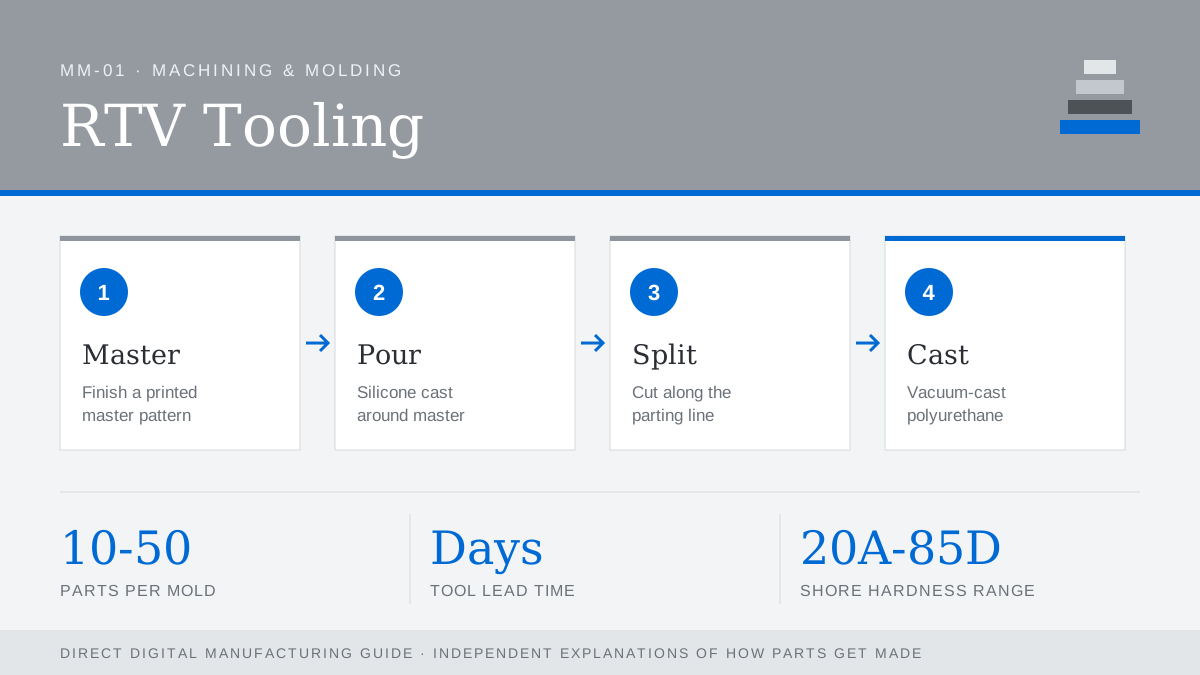
RTV stands for room-temperature vulcanizing silicone. To make an RTV tool, a master pattern (often an SLA print) is suspended in a box, liquid silicone is poured around it and cured, and the block is cut open along a parting line. Polyurethane resin is then poured or vacuum-cast into the cavity. Each mold typically yields somewhere between 10 and 50 parts before the silicone tears or loses detail.
Why use it
- Speed. A mold can be ready within days of having a finished master.
- Material range. Urethane casting resins imitate ABS, polypropylene, clear polycarbonate and rubber across a wide Shore hardness range.
- Color and texture. Pigments can be added to the resin, and the silicone copies the master’s surface exactly.
- Overmolding. Inserts and soft-touch layers are easy to add.
Limits
- Parts are castings, not true production thermoplastics, so certification testing usually still needs molded parts.
- Tolerances are looser than injection molding, typically a few tenths of a millimetre on larger parts.
- Labor per part is high, so it stops making sense beyond a few hundred units.
Getting good results
The master is everything: any flaw in it appears in every casting. Finish the master to the exact surface you want, design generous draft where possible, and agree the parting line early so it lands on a non-cosmetic edge.