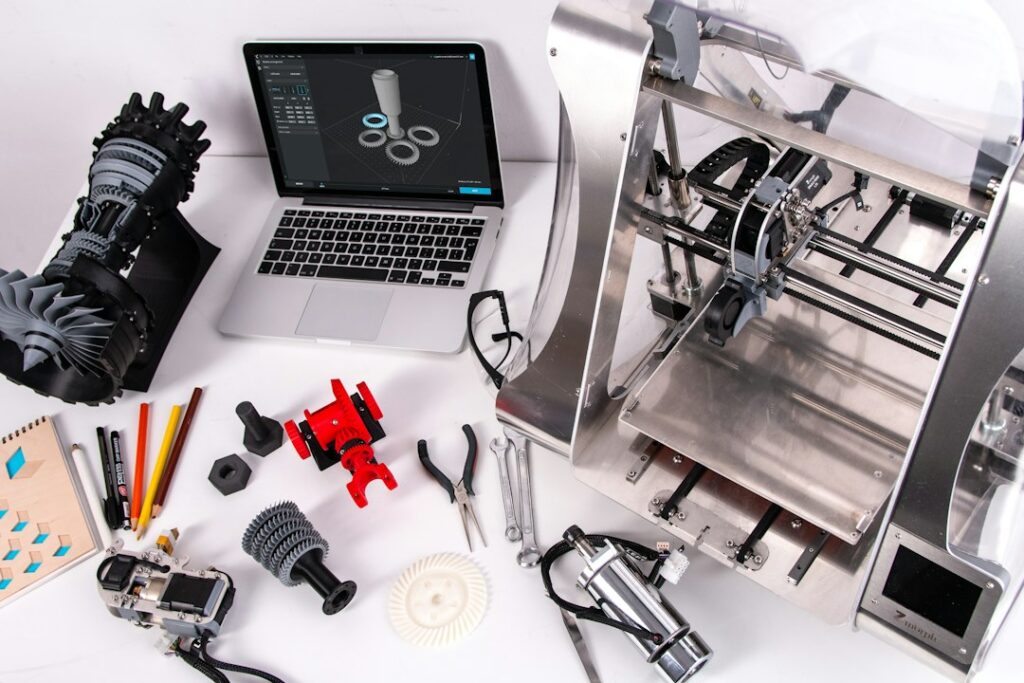
Additive manufacturing (AM) is the umbrella term for processes that build a part by adding material one thin layer at a time, straight from a CAD file. Instead of cutting a shape out of a block, the machine slices the model into cross-sections and fuses, cures or deposits each one in turn. That simple idea removes most of the tooling cost and lead time from low-volume work, and lets engineers make shapes that no mill or mold could reach.
The four families covered here
- Powder bed fusion of polymers (plastic laser sintering): tough nylon parts with no support structures.
- Vat photopolymerization (stereolithography): the smoothest surfaces and finest detail.
- Powder bed fusion of metals (selective laser melting / DMLS): dense, functional metal parts in titanium, nickel alloys, steels and aluminum.
- Material extrusion (fused deposition modeling): engineering thermoplastics on large build platforms.
A quick way to choose
| Need | Usually start with |
|---|---|
| Snap fits, living hinges, durable housings | Plastic laser sintering |
| Show models, master patterns, fine features | Stereolithography |
| Load-bearing metal, heat, internal channels | Selective laser melting |
| Large fixtures, flame-retardant or high-temperature plastics | Fused deposition modeling |
Rule of thumb: pick the material first, then the process that offers it, then check that the tolerances and surface finish you need are realistic for that process.