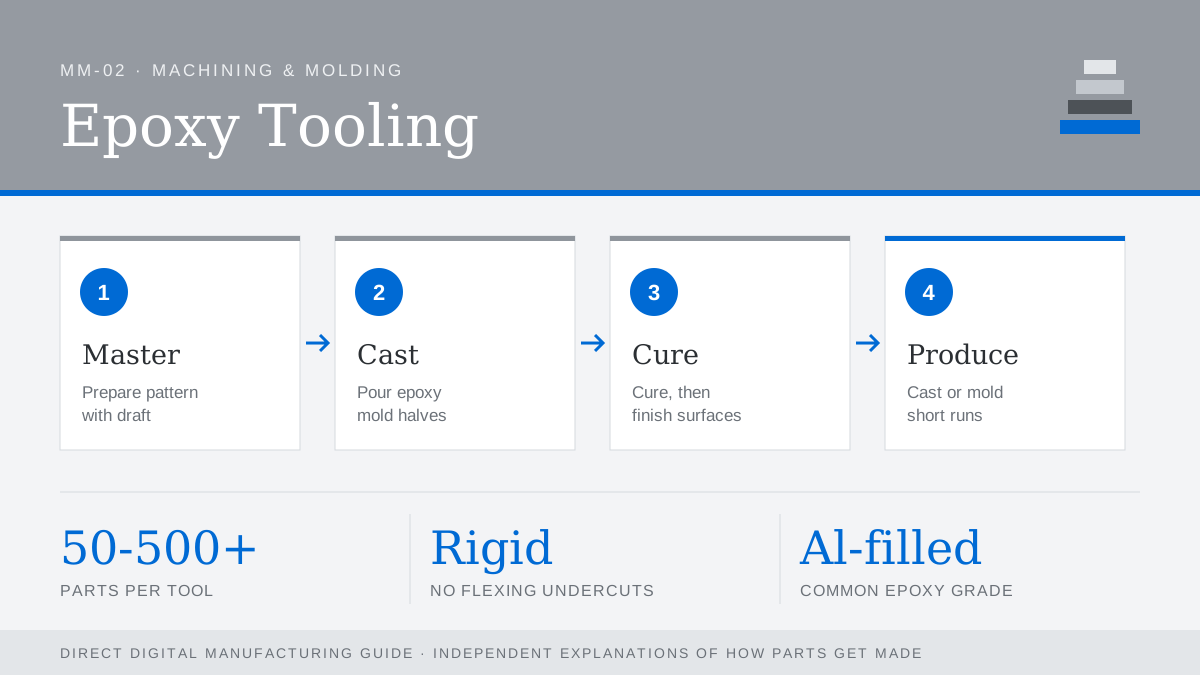
Epoxy tooling replaces flexible silicone with a rigid, often aluminum-filled epoxy. The epoxy is cast around a master pattern in two or more halves, producing a hard mold that lasts much longer than RTV silicone. Depending on the part and resin, an epoxy tool can produce from around fifty to several hundred castings, and some aluminum-filled tools are even used for very short injection-molding runs with low-pressure materials.
When it makes sense
- Quantities are too high for silicone but too low to justify a machined mold.
- You need better dimensional stability than a flexible mold gives.
- The part is used for reaction injection molding (RIM), thermoforming or composite layup, where epoxy tools are common.
Trade-offs
- A rigid mold cannot flex around undercuts, so the design needs proper draft or loose cores.
- Epoxy conducts heat poorly, so cycle times are long compared with metal tooling.
- Tools can chip at sharp edges, so add radii where possible.
Practical advice
Treat epoxy tooling as a stepping stone. It is a sensible way to get a few hundred parts into customers’ hands while the design settles, before committing to the much larger cost of a production injection mold.