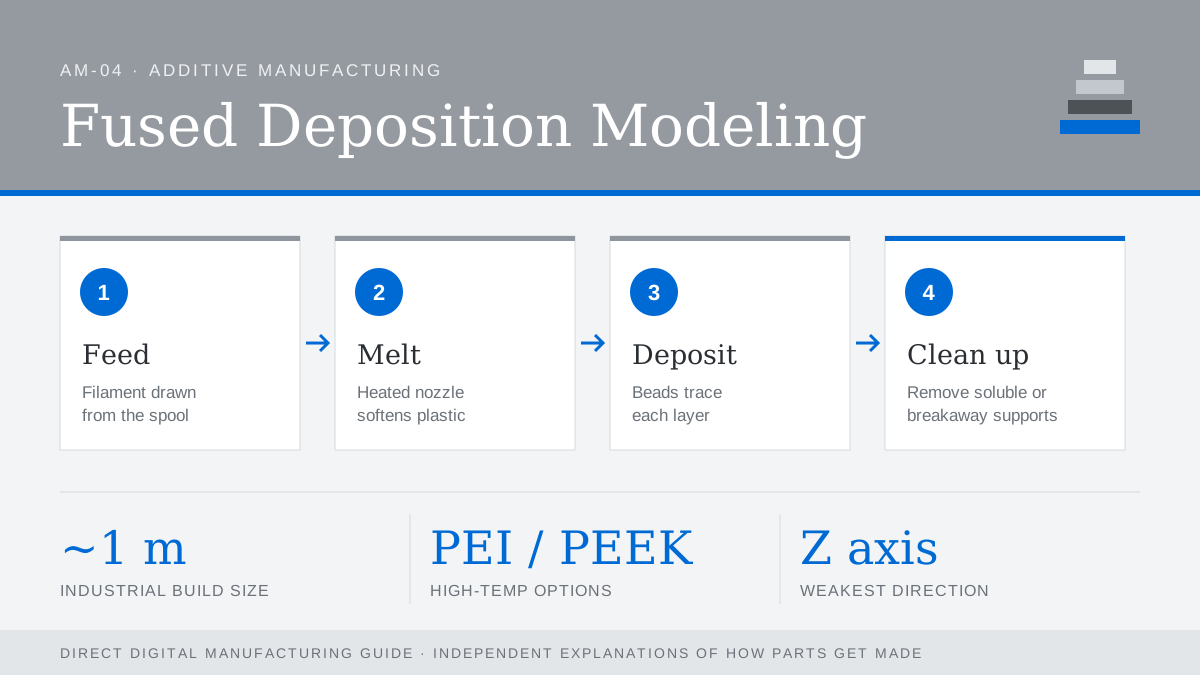
Fused deposition modeling (FDM), also called fused filament fabrication, pushes a thermoplastic filament through a heated nozzle and lays it down as beads that trace each layer. Industrial machines add heated build chambers and soluble support materials, which makes it practical to print large parts in demanding plastics.
Why it is still widely used
- Engineering materials. ABS, ASA, polycarbonate, nylon, and high-performance polymers such as ULTEM (PEI) and PEEK.
- Size. Industrial systems offer build envelopes close to a metre on a side.
- Low cost per part for fixtures, housings and prototypes that do not need a cosmetic finish.
Anisotropy
FDM parts are weakest between layers. A bracket printed lying flat can be several times stronger than the same bracket printed standing up. Orient parts so the main loads run along the bead direction, not across layer boundaries.
Design guidelines
- Wall thickness should be a multiple of the bead width for clean toolpaths.
- Add fillets where walls meet the build plate to reduce warping.
- Use heat-set threaded inserts rather than tapping plastic directly.
- Visible layer lines can be removed with sanding, filling and paint, or vapor smoothing for ABS.