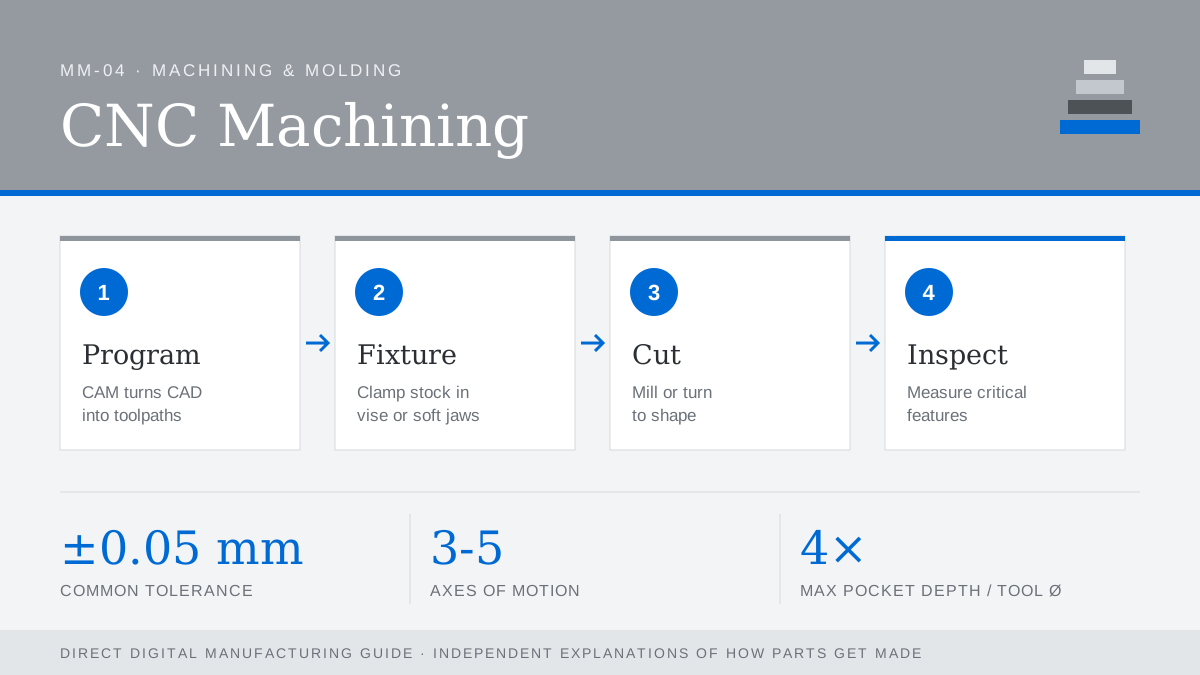
CNC (computer numerical control) machining removes material from a solid block with rotating cutters or a spinning workpiece. Milling centres handle prismatic parts; lathes handle round ones; 5-axis machines reach complex surfaces in a single setup. Because the stock is wrought material, machined parts have fully predictable properties.
Where it fits alongside additive
- Finishing printed metal. Bearing bores, sealing faces and threads on SLM parts are almost always machined.
- Low-volume production. For simple geometries, machining is often cheaper and faster than printing.
- Engineering plastics. Delrin (acetal), PEEK, nylon and polycarbonate machine well for functional prototypes.
Design for machinability
- Inside corners always have a radius equal to the cutter; design for it rather than fighting it.
- Keep pocket depths to roughly four times the tool diameter where you can.
- Specify tight tolerances only where they matter; general tolerances cut cost.
- Use standard hole and thread sizes to avoid special tooling.
Choosing between CNC and 3D printing
If the part can be made from a block in a few setups and the material matters, machine it. If it has internal channels, organic shapes or would waste most of an expensive billet, print it, then machine the critical features.