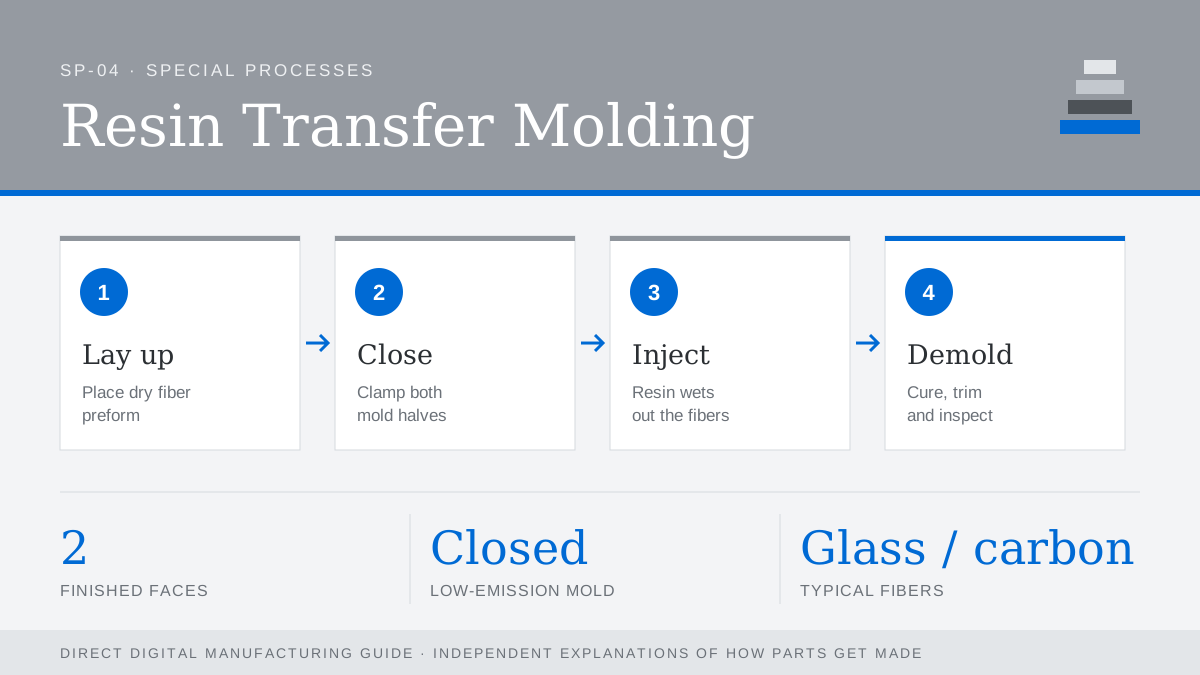
Resin transfer molding (RTM) is a closed-mold composite process. Dry fiber reinforcement (glass, carbon or aramid fabric, often preformed to shape) is placed in a two-sided mold. The mold is closed and a liquid thermoset resin, usually epoxy, is injected under pressure until it wets out the fibers. After the resin cures, the part comes out with a molded finish on both faces.
Advantages over open molding
- Consistent fiber content and thickness from part to part.
- Two finished surfaces and tight dimensional control.
- Lower emissions because the resin stays enclosed.
- Integrated features such as inserts and foam cores molded in place.
Variants
| Variant | Difference |
|---|---|
| VARTM / vacuum infusion | One rigid side and a vacuum bag; cheaper tooling |
| Light RTM | Semi-rigid upper mold, lower pressure |
| High-pressure RTM | Fast-curing resins for automotive volumes |
Where additive manufacturing helps
Printed patterns and mold masters shorten tooling lead time, and water-soluble or breakaway printed cores make hollow composite parts possible. Washout cores in particular let designers make ducts and tubes that cannot be demolded conventionally.