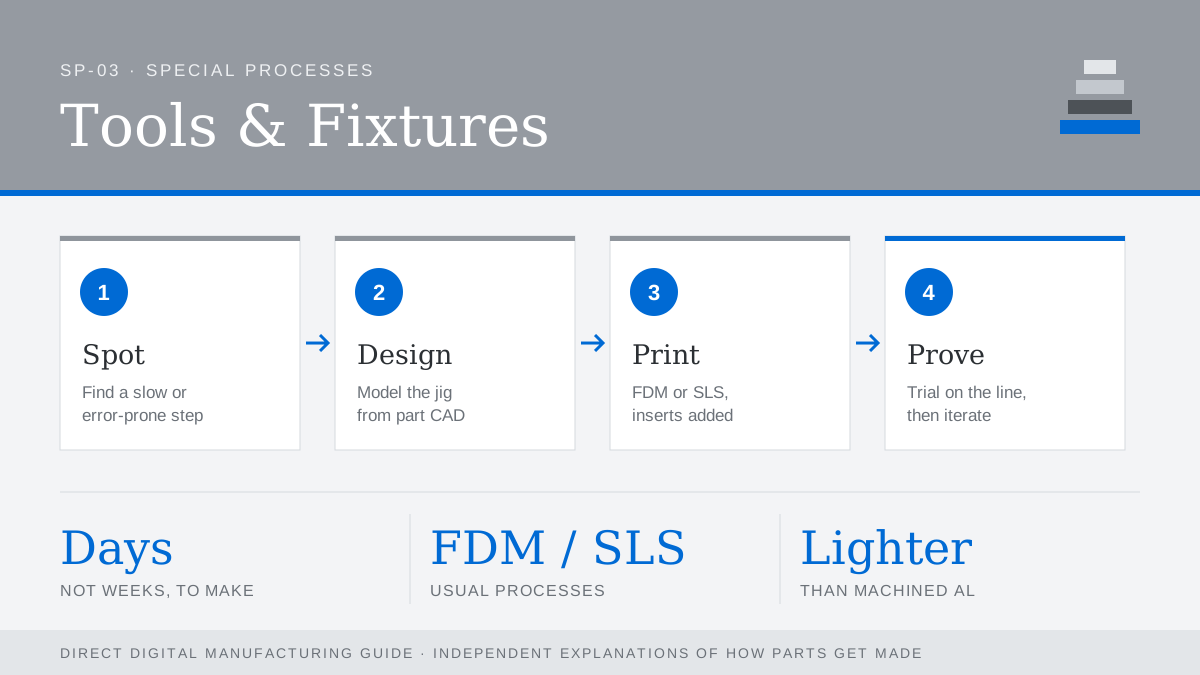
Some of the highest returns from 3D printing come from parts customers never see: the jigs, fixtures, gauges and end-of-arm tools that hold, locate and check production parts. These are typically one-off or low-quantity items with complex shapes, which is exactly where additive manufacturing beats machining on cost and lead time.
Typical applications
- Assembly jigs that locate components for bonding, riveting or fastening.
- Drill and trim guides shaped to match a part’s contours.
- Go/no-go and inspection gauges that let operators check features without a CMM.
- Robot grippers with internal vacuum or air channels and less weight than machined aluminum.
- Soft jaws and nests that protect finished surfaces during machining.
Choosing the process
FDM in ABS, ASA or carbon-filled nylon covers most fixtures. SLS suits small, durable parts in batches. Use metal printing or machined inserts where wear is concentrated, such as bushings for drill guides.
Design tips
- Print the operator’s instructions, part numbers or arrows directly into the fixture.
- Add pockets for magnets, threaded inserts or locating pins.
- Lighten large fixtures with internal infill or lattices to reduce operator fatigue.