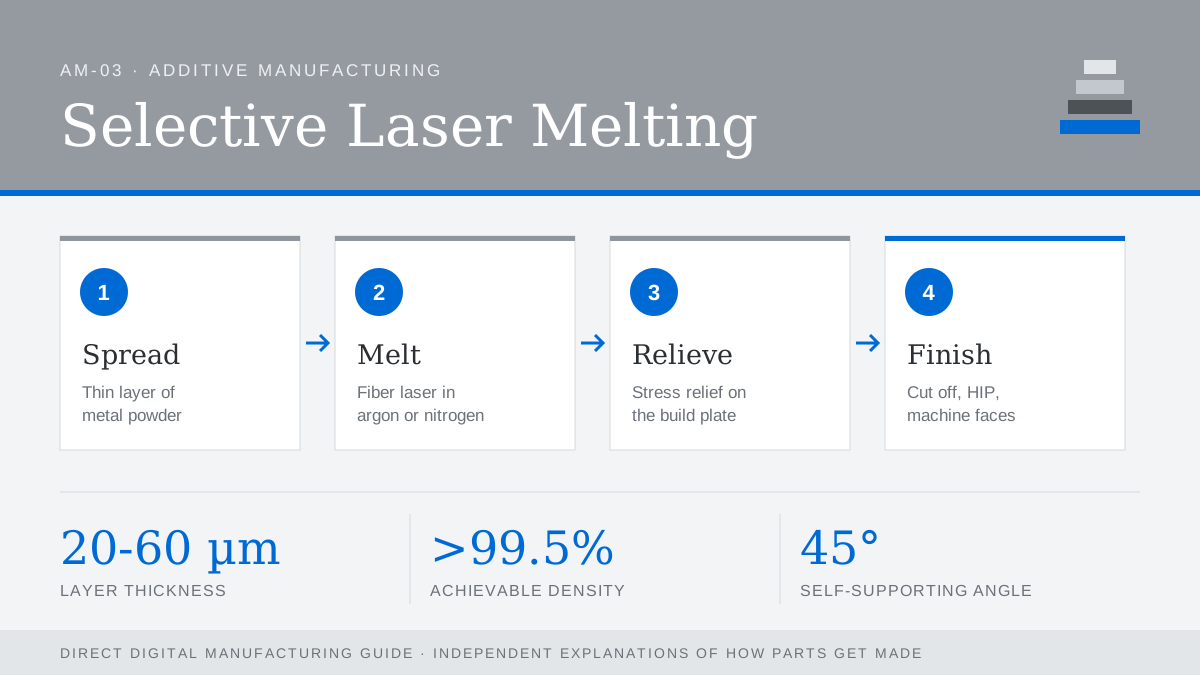
Selective laser melting (SLM), also sold under names like direct metal laser sintering (DMLS) or laser powder bed fusion (L-PBF), works like plastic sintering with metal. A recoater spreads a thin layer of metal powder, a high-power fiber laser fully melts the cross-section in an inert argon or nitrogen atmosphere, and the process repeats. The result is a part close to full density, with mechanical properties comparable to cast and in some cases wrought material.
Where it shines
- Internal features. Conformal cooling channels, lattices and consolidated assemblies that would otherwise need many parts.
- Hard-to-machine alloys. Titanium and nickel superalloys are expensive to cut; printing near-net shape saves material.
- Weight reduction. Topology-optimized brackets and aerospace hardware.
Common alloys
| Alloy | Typical use |
|---|---|
| Ti-6Al-4V | Aerospace, medical implants |
| Inconel 718 / 625 | Hot-section and high-temperature parts |
| 316L stainless | Corrosion-resistant hardware |
| AlSi10Mg | Lightweight housings and heat exchangers |
| Maraging steel, 17-4PH | Mold inserts, tooling |
The hidden steps
Metal printing is rarely finished when the machine stops. Parts are welded to the build plate and need stress relief, removal by wire EDM or saw, support removal, and often hot isostatic pressing (HIP) to close internal porosity. Critical surfaces are then machined. Budget for these steps from the start.
Design rules
- Surfaces angled less than about 45° from horizontal usually need supports.
- Prefer teardrop or diamond-shaped horizontal holes over round ones larger than ~8 mm.
- Leave machining stock on sealing faces and bores.